
By: Sachet A. Carter | The Zion Times
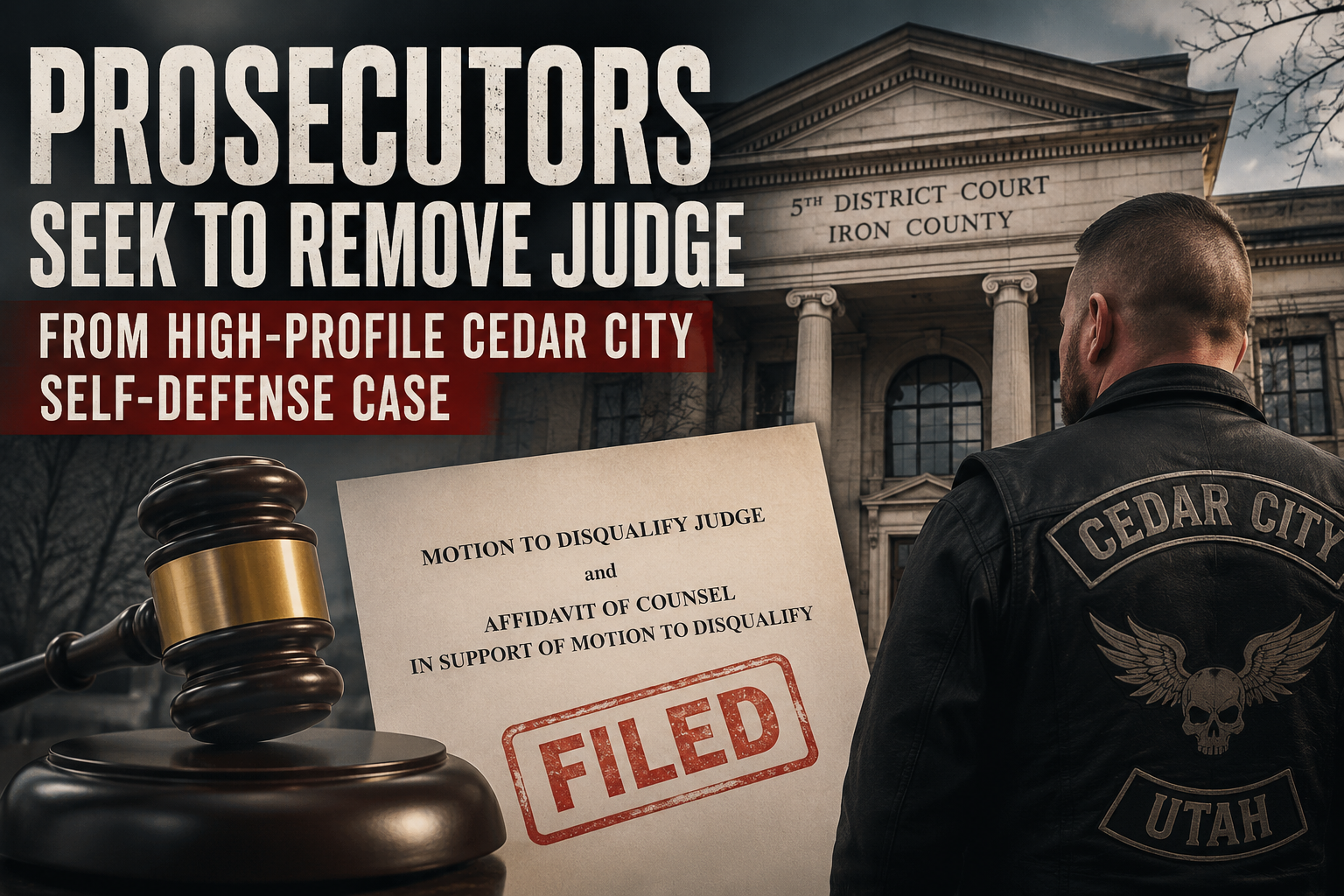
In a shocking move by the state, the Iron County Attorney’s Office has filed a motion asking a 5th District Court Judge to remove himself from one of Cedar City’s most high-profile criminal cases.
The motion comes nearly a year after Judge Meb W. Anderson issued a landmark justification ruling, finding that Jason Bryan Stolworthy acted in lawful self-defense when he shot another man during a road rage confrontation near a local gas station. In his ruling, Anderson concluded the State failed to prove by clear and convincing evidence that Stolworthy’s use of deadly force was not justified.
According to court records filed in 5th District Court, prosecutors first met privately with Judge Anderson and defense counsel in chambers on July 21st, requesting that he voluntarily recuse himself from the case, which Judge Anderson declined. Ten days later, the Iron County Attorney’s Office filed a formal motion asking that Anderson be disqualified from further proceedings, arguing that his “impartiality might reasonably be questioned.”
The State’s Motion to Disqualify and accompanying Affidavit of Counsel allege the request is based on the totality of the circumstances and not a single event. Prosecutors cite Judge Anderson’s review of character letters submitted in support of Stolworthy’s bail, including one authored by a Southern Utah University administrator with whom Anderson acknowledged a prior professional relationship; his recognition of several supporters of the defendant during the justification hearing; his decision to reduce Stolworthy’s bail from $200,000 to $10,000 without a formal request from the defense; a social connection between the judge’s wife and Stolworthy’s wife; and statements made during the July 21 in-chambers meeting that prosecutors argue raise additional concerns regarding the proceedings.
The motion is only the latest chapter in a case that has taken numerous unexpected turns since it began more than two years ago.
What started as a confrontation between two strangers at a Cedar City intersection has evolved into one of the most closely watched criminal prosecutions in Southern Utah, testing the limits of Utah’s self-defense laws, prompting a controversial pretrial justification hearing, and culminating with prosecutors asking that the judge who dismissed most of the charges to step aside
THE BEGINNING: FROM A TRAFFIC DISPUTE TO GUNFIRE
The events that would ultimately lead to Stolworthy’s arrest and prosecution began on the afternoon of June 12, 2024, at one of Cedar City’s busiest intersections. What initially appeared to be a routine traffic dispute would, within minutes, escalate into a shooting that left one man seriously injured and another facing several felony charges.
According to the Affidavit of Probable Cause and subsequent court filings, Cedar City Police first received a report of a road rage incident shortly after noon on June 12, 2024. The report indicated a motorcyclist, later identified as Jason Stolworthy, and the driver of a white Mercedes SUV, later identified in court records as RM (Mabbitt), had been involved in a physical altercation near the intersection of Main and Center streets in Cedar City before driving away. The reporting party further stated the motorcyclist then began aggressively following the Mercedes.
According to prosecutors, the confrontation began after Stolworthy allegedly rode his motorcycle between two northbound lanes of stopped traffic and stopped near the front of the Mercedes while both vehicles waited at a red light. When the light turned green, prosecutors allege Stolworthy remained between the lanes and proceeded slowly through the intersection before slowing and eventually stopping in the roadway. RM later told investigators the motorcycle allegedly “brake checked” him, which led him to stop behind the motorcycle and exit his vehicle. Witnesses reported Stolworthy then got off his motorcycle, and the two began arguing over Utah’s lane-filtering law.
During the argument, Stolworthy reportedly walked towards RM at which point RM pushed him in the helmet. RM told investigators Stolworthy responded by saying “he did not want to fight” to which, RM replied it was a “good thing” because he would “beat [his] ass.”
Witnesses present during the confrontation described the incident somewhat differently. One characterized it as a “short encounter” during which RM was “aggressively punching” Stolworthy. Another reported RM pushed Stolworthy and struck his helmet, while a third recalled only that RM pushed him. However, multiple witnesses consistently reported that RM returned to his Mercedes first and continued north on Main Street. According to those witnesses, Stolworthy remained behind for a short time until RM was nearly a block away before getting back on his motorcycle and allegedly chasing him. Surveillance footage obtained by investigators from State Bank of Southern Utah reportedly show the Mercedes passing first, followed moments later by Stolworthy riding at what appeared to be a high rate of speed while passing vehicles on the shoulder.

Make a one-time donation
Make a monthly donation
Make a yearly donation
Choose an amount
Or enter a custom amount
Your contribution is appreciated.
Your contribution is appreciated.
Your contribution is appreciated.
One witness reported Stolworthy cut off RM near Brad’s Food Hut, causing RM to swerve around the motorcycle. During the pursuit, Stolworthy was reportedly almost run off the road by a third vehicle, which resulted in his helmet striking and bending the vehicle’s side mirror.
Minutes after the pursuit up Main Street, police dispatch received additional reports that the confrontation had escalated near the KB Express at Main Street and Fiddlers Canyon Drive. According to prosecutors, RM swerved across the right lane before turning east onto Fiddlers Canyon Drive and stopping in front of an office building near the KB Express. Stolworthy reportedly followed RM and stopped directly behind his Mercedes. Court filings state RM exited his vehicle and approached Stolworthy, where the two resumed arguing. During the confrontation, RM reportedly struck Stolworthy in the helmet before Stolworthy drew a handgun and fired a single shot into RM’s chest. The round reportedly struck RM and then entered a nearby vehicle recording the incident.
After the shooting, Stolworthy fled into a residential neighborhood. Officers later located him at his residence, where investigators alleged he was attempting to load his motorcycle into the bed of a pickup truck. Court records state investigators found the motorcycle’s rear license plate bent upward, which they alleged was done to conceal the motorcycle’s identity from law enforcement. After executing a search warrant on the home, officers reportedly recovered a handgun from the driveway and later seized additional evidence from the home, including a motorcycle helmet, a green backpack, black gloves and ammunition investigators alleged matched the shell casing recovered at the shooting scene.
According to the court records, RM sustained serious bodily injuries but ultimately survived the shooting after being flown to St George Regional Hospital for medical treatment. Stolworthy was booked into the Iron County Jail with several felonies, including one first-degree felony for discharging a firearm causing serious bodily injury, two second-degree felonies for aggravated assault resulting in serious bodily injury and obstruction of justice as well as a class B misdemeanor for reckless driving and two class A misdemeanors for reckless endangerment.
The criminal case that followed would span more than two years, resulting in multiple evidentiary hearings, a landmark ruling on Utah’s self-defense laws and, ultimately, the State’s final motion seeking to disqualify the judge who issued it.
THE MOTION FOR A PRETRIAL JUSTIFICATION HEARING
Roughly five months after the shooting, Stolworthy’s initial defense attorney, Jack Burns, filed a Motion for a Pretrial Justification Hearing, arguing his client acted lawfully in self-defense during the June 12, 2024 confrontation. Filed on November 11, 2024, the motion asked the court to hear evidence under Utah Code § 76-2-309 and determine, before trial, whether Stolworthy’s use of deadly force was legally justified under Utah’s self-defense statutes.
Unlike a traditional criminal trial, a pretrial justification hearing places a different burden on the parties. Once a defendant presents a prima facie claim of justification, Utah law requires the prosecution to prove by clear and convincing evidence that the defendant’s use of force was not justified. If the State fails to meet that burden, the defendant is entitled to immunity from prosecution on the justified charges. Prosecutors opposed Stolworthy’s motion, arguing the evidence overwhelmingly demonstrated that his actions were neither reasonable nor legally justified.
THE STATE’S ARGUMENT
In two separate bench briefs filed before the justification hearing, Deputy Iron County Attorney Trajan Evans urged the court to deny Stolworthy’s motion, arguing the evidence established he was the aggressor and that deadly force was neither necessary nor reasonable under Utah law. One brief addressed Utah’s general self-defense statute, while the second focused on the defense of an occupied vehicle.
Prosecutors argued that whatever danger existed during the initial confrontation at Main and Center streets ended once RM returned to his vehicle and drove away. According to the State, Stolworthy chose to pursue RM for more than two miles before stopping behind him near the KB Express, transforming any later use of force into retaliation rather than self-defense. Evans argued Stolworthy could have driven away at numerous points during the pursuit but instead continued following RM until the final confrontation occurred.
The State further argued RM was unarmed throughout both encounters and never threatened Stolworthy with a weapon. Prosecutors contended the force used by RM was relatively minor compared to Stolworthy’s use of deadly force, noting that Stolworthy was wearing a motorcycle helmet and appeared largely unaffected by the punches described by witnesses. Because RM suffered a gunshot wound while Stolworthy sustained only minor injuries, prosecutors argued the shooting constituted a disproportionate response to the circumstances.
Evans also argued Stolworthy’s conduct immediately after the shooting demonstrated he did not genuinely believe his actions were legally justified. Prosecutors pointed to his decision to leave the scene without calling 911, allegations that he concealed his motorcycle’s license plate, and evidence that officers found him attempting to load the motorcycle into a pickup truck when they arrived at his residence. The State further argued Stolworthy’s actions upon surrendering to police reflected remorse inconsistent with someone who believed deadly force had been necessary.
Based on those arguments, prosecutors asked Judge Anderson to deny Stolworthy’s motion and allow the criminal case to proceed toward trial.
JUDGE ANDERSON REACHES A DIFFERENT CONCLUSION
After reviewing testimony, surveillance footage, physical evidence and extensive legal briefing presented during the justification hearing, Judge Anderson reached a dramatically different conclusion than the one advanced by prosecutors.
In a detailed 14-page ruling, Anderson concluded the State failed to prove by clear and convincing evidence that Stolworthy’s use of deadly force was not legally justified under Utah law.
“The Court finds the State failed to carry its burden of proving by clear and convincing evidence Stolworthy’s use of force was not justified.”
— Judge Meb W. Anderson
Ruling & Order Re: Justification Hearing, p. 11, ¶ 2.
Unlike a criminal trial, the question before the court was not whether Stolworthy fired the gun. That fact was never disputed. Instead, the issue was whether prosecutors had proven Stolworthy’s actions fell outside Utah’s self-defense statutes. Judge Anderson ultimately concluded they had not.

with
The Zion Times
THE PURSUIT
One of the State’s central arguments was that Stolworthy became the aggressor by pursuing RM after the initial confrontation at Main and Center streets. Judge Anderson acknowledged the pursuit but found the evidence presented at the hearing supported a different explanation than the one offered by prosecutors.
According to the ruling, Stolworthy testified he attempted to retrieve his cellphone and photograph RM’s license plate so he could report the incident to police. However, because he was wearing motorcycle gloves, he was unable to remove the phone from his pocket before RM drove away. The court found Stolworthy then decided to follow the Mercedes in an effort to obtain the license plate number.
“Stolworthy tried to get his phone out of his pocket to snap a picture of Mabbitt’s license plate to report the incident to the police but was wearing gloves and failed to capture it before Mabbitt had driven away. Stolworthy then decided to follow Mabbitt to get the photograph.”
— Judge Meb W. Anderson
Ruling & Order Re: Justification Hearing, p. 3, Findings of Fact ¶¶ 20–21.
The judge later rejected the State’s contention that the pursuit, by itself, made Stolworthy the aggressor.
“Stolworthy’s chasing of Mabbitt is also not relevant… Utah courts have routinely held that ‘an individual does not have a duty to retreat from the force or threatened force… and the failure of an individual to retreat… is not a relevant factor in determining whether the individual who used or threatened force acted reasonably.“
— Judge Meb W. Anderson
Ruling & Order Re: Justification Hearing, pp. 12–13, ¶¶ 1-4.
THE SECOND CONFRONTATION
Judge Anderson devoted much of his ruling to the final confrontation outside the KB Express, carefully comparing witness testimony with surveillance footage captured from nearby businesses and a bystander’s cellphone.
While prosecutors argued Stolworthy escalated the encounter by following RM, Anderson found the evidence demonstrated the confrontation continued after RM exited his vehicle and approached Stolworthy’s motorcycle.
The court found RM struck Stolworthy repeatedly while Stolworthy remained seated on his motorcycle.
“Mabbitt punched Stolworthy in the head at least three times immediately before Stolworthy pulled his firearm. The punches, while on his helmet, went through Stolworthy’s visor and broke his skin… Even when Stolworthy pulled the gun, before he fired, Mabbitt saw the gun and continued charging towards Stolworthy. It was reasonable for Stolworthy to assume the punching onslaught, or worse, would continue if he had not fired his weapon.”
— Judge Meb W. Anderson
Ruling & Order Re: Justification Hearing, p. 8, ¶¶ 2–5.
The court also rejected the State’s suggestion that Stolworthy could have safely retreated before firing.
“Footage clearly shows Stolworthy tried to retreat from his bike and Mabbitt immediately prior to the shooting… Stolworthy was reasonable to assume that Mabbitt charging around the motorcycle, straight at Stolworthy, would initiate a third encounter.”
— Judge Meb W. Anderson
Ruling & Order Re: Justification Hearing, p. 8, ¶ 6.
RM’S THREATS
Judge Anderson also found significant that RM repeatedly threatened to kill Stolworthy during the encounter. Those threats, coupled with the escalating physical assault captured on surveillance video, became a key factor in the court’s analysis of whether Stolworthy reasonably believed he faced an imminent threat of serious bodily injury or death.
The ruling notes RM first threatened Stolworthy during the initial confrontation at Main Street and Center Street, telling him he was going to “fucking kill” him after confronting him about lane filtering. The court found those threats did not end there. Instead, Anderson concluded they carried forward into the final confrontation outside the KB Express, where RM again aggressively approached Stolworthy after exiting his Mercedes.
“Finally, Mabbitt stated more than once that he would ‘fucking kill’ Stolworthy for lane filtering. Based on his words and behavior, it is not unreasonable for Stolworthy to be genuinely afraid and believe that shooting Mabbitt was necessary to defend himself against a person charging him with a stated intent to kill him.”
— Judge Meb W. Anderson
Ruling & Order Re: Justification Hearing, p. 8, ¶ 7.
Anderson later returned to that finding when evaluating the objective reasonableness of Stolworthy’s actions, writing that a reasonable person could conclude RM had already demonstrated a willingness to carry out those threats.
“He had also told Stolworthy that he would ‘fucking kill’ him… As the Utah Supreme Court found in Clara: ‘In this moment, a reasonable person could believe that the demonstrably violent [Mercedes driver] had reneged and was going to attack again.“
— Judge Meb W. Anderson
Ruling & Order Re: Justification Hearing, p. 10, ¶ 1.
“STOLWORTHY NEED NOT WAIT”
Perhaps the strongest language in Anderson’s ruling addressed the State’s argument that Stolworthy should have waited longer before resorting to deadly force.
Instead, the court concluded Utah law did not require Stolworthy to endure additional blows before defending himself.
“The Court finds that Stolworthy had the prerequisite intent for self-defense. His belief that the threat was imminent enough to pull and use his handgun was necessary and reasonable… Stolworthy need not wait to see how hard Mabbitt would hit him again.”
— Judge Meb W. Anderson
Ruling & Order Re: Justification Hearing, p. 10, ¶ 3.
Judge Anderson further concluded the evidence established both the subjective and objective components of self-defense, finding a reasonable person in Stolworthy’s position could have believed another violent attack was imminent.
THE STATE FAILED TO MEET ITS BURDEN
Throughout the ruling, Anderson repeatedly emphasized that the burden rested with the prosecution—not Stolworthy.
The court concluded prosecutors failed to establish that Stolworthy provoked the confrontation with the intent to inflict bodily harm or that he qualified as the aggressor under Utah’s statutory exceptions.
“The State’s video evidence shows that Stolworthy was not the instigator or aggressor at the shooting scene… The clear and convincing evidence does not show Stolworthy chased down Mabbitt to inflict bodily harm.”
— Judge Meb W. Anderson
Ruling & Order Re: Justification Hearing, p. 13, ¶¶ 2–4.
The court likewise rejected the State’s argument that Stolworthy withdrew from the encounter only to reengage, finding the evidence instead showed RM continued advancing toward Stolworthy as the confrontation escalated.
Ultimately, Anderson dismissed the first-degree felony discharge of a firearm causing serious bodily injury, the second-degree felony aggravated assault charge and both reckless endangerment charges with prejudice. The obstruction of justice and reckless driving charges were left unresolved pending further proceedings. (Ruling & Order Re: Justification Hearing, p. 14, Conclusions & Orders ¶¶ 1–7.)
ONLY TWO CHARGES REMAINED
Following Judge Anderson’s justification ruling, only two charges remained pending against Stolworthy: one second-degree felony count of obstruction of justice and one class B misdemeanor count of reckless driving. Several months later, Stolworthy retained veteran defense attorney Scott Garrett, who immediately challenged the remaining felony charge, arguing Judge Anderson’s justification ruling had fundamentally altered the legal basis for the obstruction count.
In a motion filed June 22, 2026, Garrett argued the obstruction charge was predicated entirely on Stolworthy’s conduct following the shooting, specifically allegations that he bent his motorcycle’s license plate and attempted to load the motorcycle into the bed of a pickup truck. Because Judge Anderson had already ruled Stolworthy acted in lawful self-defense and dismissed the underlying first-degree felony discharge charge with prejudice, Garrett argued there was no longer a predicate criminal offense capable of supporting the obstruction charge or its second-degree felony enhancement.
Garrett further argued Judge Anderson’s factual findings undercut the State’s obstruction theory. He pointed to the court’s findings that RM was “always the aggressor,” that Stolworthy followed RM only because he was unable to retrieve his cellphone while wearing motorcycle gloves and wanted to obtain RM’s license plate number, and that Stolworthy admitted he “was not thinking rationally after the shooting.” Garrett argued those findings were fundamentally inconsistent with the deliberate intent required to commit obstruction of justice.
The Iron County Attorney’s Office opposed the motion, arguing Garrett’s interpretation conflicted with Utah law. Prosecutors maintained obstruction of justice does not require a conviction—or even the continued existence of an underlying criminal charge. Instead, they argued the offense turns on whether a defendant intentionally attempted to hinder a criminal investigation. Relying heavily on the Utah Supreme Court’s decision in State v. Paule, prosecutors argued a reasonable jury could conclude Stolworthy believed he was legally at risk after shooting RM and intentionally sought to hinder the investigation by fleeing the scene, failing to call 911, bending his motorcycle’s license plate and attempting to conceal the motorcycle in the bed of a pickup truck.
Garrett’s reply shifted the legal battle from the facts to the interpretation of Paule. He argued prosecutors relied on an interpretation of law that the Utah Supreme Court had expressly rejected. Garrett explained that obstruction of justice, like most criminal offenses, requires proof of both actus reus—the criminal act itself and mens rea—a guilty mind or criminal intent. He argued the Utah Supreme Court made clear the relevant inquiry was not what police believed they were investigating, but whether Stolworthy himself specifically intended to hinder an investigation into conduct he believed constituted a criminal offense. Garrett further argued Judge Anderson’s factual findings—that Stolworthy acted in lawful self-defense and admitted he was “not thinking rationally after the shooting”—substantially undermined any claim that he possessed the specific criminal intent necessary to sustain the obstruction charge.
Prosecutors responded with a sur-reply, arguing Garrett had abandoned the theories raised in his original motion after those arguments failed under Paule and instead advanced entirely new arguments concerning actus reus and mens rea. The State maintained the evidence presented during the preliminary hearing was sufficient to allow a jury to determine whether Stolworthy acted with the specific intent necessary to commit obstruction of justice. Prosecutors argued a reasonable jury could infer Stolworthy believed he was legally at risk based on his conduct after the shooting, including fleeing the scene, failing to call 911, bending his license plate, attempting to conceal his motorcycle and repeatedly striking himself in the head after the shooting.
The parties completed briefing in July 2026, and the court scheduled oral arguments on Garrett’s motion. Before attorneys could argue whether the remaining felony charge should be dismissed, however, the case took another unexpected turn.
According to the State’s subsequently filed Motion to Disqualify, prosecutors met privately with Judge Anderson and defense counsel in chambers on July 21, 2026, where they asked Anderson to voluntarily recuse himself from the case. When the judge declined, the hearing on Garrett’s motion never occurred. Ten days later, prosecutors filed the motion now at the center of the dispute, asking that Anderson be removed from all further proceedings.

with
The Zion Times.
THE MOTION TO DISQUALIFY
In their Motion to Disqualify the Judge and accompanying Affidavit of Counsel, prosecutors argue Judge Anderson’s impartiality “might reasonably be questioned” based not on any single incident, but on what they describe as the cumulative effect of numerous events that occurred throughout the proceedings. Citing Rule 2.11 of Utah’s Code of Judicial Conduct, the State argues a reasonable person could conclude Anderson demonstrated the appearance of favoritism toward Stolworthy, warranting his removal from the case.
The State’s first allegation centers on Judge Anderson’s review of character letters submitted months earlier in support of Stolworthy’s request for a reduction in bail. Prosecutors argue the issue of bail had already been resolved by another judge and was not before the court during the justification hearing, making the letters irrelevant to the issues Anderson was asked to decide. According to the motion, one of those letters was authored by Southern Utah University’s Assistant Dean of Students, whom Anderson acknowledged he had previously worked with, provided legal advice to on multiple occasions and interviewed for a university position. The State further notes the Assistant Dean described Stolworthy as a “close friend,” expressed opinions regarding Stolworthy’s character and asserted he believed Stolworthy acted in self-defense. Prosecutors argue Anderson had no reason to review those materials before deciding the justification hearing and contend his prior relationship with the author contributes to the appearance of partiality.
Prosecutors next focus on statements Judge Anderson made at the outset of the justification hearing, when he acknowledged recognizing “a number” of individuals seated in the courtroom. According to the motion, many, if not all, of those individuals were present in support of Stolworthy. The State further alleges several of those supporters had previously contacted prosecutors to express displeasure with the prosecution and argues they attempted to use their familiarity with both prosecutors and the court to benefit the defendant. Although Anderson denied anyone had approached him about the case, prosecutors contend the circumstances nonetheless contribute to an appearance of favoritism.
The motion also challenges Anderson’s decision to reduce Stolworthy’s bail from $200,000 to $10,000 immediately after issuing his justification ruling. Prosecutors argue the reduction was made sua sponte—on the court’s own initiative—despite no formal motion requesting a bail reduction. According to the State, previous defense counsel had privately sought prosecutors’ agreement to reduce bail to that exact amount because of the financial hardship it imposed on Stolworthy and his family. Prosecutors argue the court’s order granted precisely the relief defense counsel had unsuccessfully sought without the issue ever being placed before the court.
The State also points to what it characterizes as a social connection between Judge Anderson’s wife and Stolworthy’s wife. According to both the motion and accompanying affidavit, Anderson disclosed during the July 21 in-chambers meeting that his wife and Stolworthy’s wife had attended the same social gathering several years earlier after discussing the case when they saw it reported in the newspaper. Prosecutors additionally note the two women are Facebook friends and argue that relationship, when considered alongside the other circumstances identified in the motion, contributes to the appearance that Anderson’s impartiality might reasonably be questioned.
Finally, prosecutors argue comments Anderson allegedly made during the July 21 in-chambers meeting raised new concerns about whether he had fully reviewed the State’s briefing on Garrett’s pending Motion to Dismiss. According to the motion, Anderson repeatedly stated he had presided over Stolworthy’s preliminary hearing and bound him over for trial. Prosecutors contend that assertion was incorrect because Judge Jeffrey C. Wilcox—not Anderson—presided over the preliminary hearing. The State argues the mistake was significant because a substantial portion of its sur-reply relied on Judge Wilcox’s bindover ruling. Prosecutors contend Anderson’s repeated statements created the appearance that he had not read or considered the State’s briefing before the scheduled oral argument, reinforcing what they characterize as a pattern of favoritism toward the defense. It was those concerns, according to the motion, that prompted prosecutors to first seek Anderson’s voluntary recusal before filing the formal Motion to Disqualify ten days later.
WHAT HAPPENS NEXT?
Under Utah law, filing a motion to disqualify does not automatically remove a judge from a case or halt the proceedings. Instead, the challenged judge must first decide whether to voluntarily recuse himself. If the judge declines, as Judge Anderson did during the July 21 in-chambers meeting, the motion is then referred to another judge for an independent determination. That judge does not decide whether the original rulings were legally correct. Rather, the issue is whether the facts alleged in the motion would cause a reasonable person to question the judge’s impartiality.
If the motion is granted, Judge Anderson will be removed from the case and a new judge will be assigned to preside over the remaining proceedings, including attorney Scott Garrett’s pending motion to dismiss the obstruction of justice charge. The newly assigned judge would determine how the case proceeds from that point forward.
If the motion is denied, Judge Anderson will remain assigned to the case and will resume consideration of the unresolved motions, including Garrett’s challenge to the obstruction charge, before the case moves toward its next phase.
SOURCES
- Affidavit of Probable Cause, State of Utah v. Jason Bryan Stolworthy.
- Motion for Pretrial Justification Hearing.
- State’s Bench Brief Regarding Pretrial Justification Hearing Under Utah Code § 76-2-402.
- State’s Bench Brief Regarding Defense of an Occupied Vehicle.
- Defendant’s Memorandum in Support of Pretrial Justification Hearing.
- Defendant’s Reply Memorandum in Support of Pretrial Justification.
- Ruling & Order Re: Justification Hearing (Judge Meb W. Anderson).
- Defendant’s Motion to Dismiss Obstruction of Justice Charge.
- State’s Opposition to Motion to Dismiss.
- Defendant’s Reply in Support of Motion to Dismiss.
- State’s Sur-Reply to Defendant’s Motion to Dismiss.
- Motion to Disqualify Judge.
- Affidavit of Counsel in Support of Motion to Disqualify.
- Utah Code §§ 76-2-309, 76-2-402 through 76-2-405.
- Utah Code § 78A-2-220 (Judicial disqualification procedure), if referenced.
- Utah Code of Judicial Conduct, Rule 2.11 (Disqualification).
- State v. Clara, 2024 UT 10.
- State v. Paule.
- Court records obtained through Utah Xchange.

with
The Zion Times.

Leave a Reply