
By: Sachet A. Sullivan | The Zion Times
Laughter, tears, and a profound sense of hope filled the dining room Saturday night at Cedar City’s Marriott during the annual gala for Holding Out HELP (HoH), a nonprofit founded by Tonia Tewell to support individuals leaving polygamous and extremist religious communities.

Co-hosting the event alongside Tewell were Sam and Melissa Zitting, creators of the popular YouTube channel Growing Up in Polygamy. Sam, a survivor of life in a polygamous community, shared parts of his personal story—offering an inside look at both the trauma and resilience that come with leaving such an environment. Melissa guided the evening around the theme, “The Ripple Effect,” describing it as “kindness creating ripples that turn into waves of change.”

After brief introductions and opening remarks, attendees shared dinner together. Tables were set with warm meals, blueberry cheesecake, pumpkin pie, lemonade, and water. Dessert remained available throughout the night, a small comfort as the evening’s discussion grew heavier. Cute centerpieces adorned each table, featuring small QR codes that guests could scan to donate, volunteer, or participate in the silent auction.

As plates were cleared, two survivors—Ethel Jessop and Vicki Thompson (now remarried)—took the stage.
Ethel shared her experience leaving the community with her three children and the difficult early days spent in a women’s shelter, struggling to rebuild from nothing.
Vicki spoke about her time as Warren Jeffs’ eighth wife and her journey to reclaim her life. After being exiled, she moved to New Harmony, where she worked as a caretaker, an FLDS role that assigns women to watch over other members’ children. It was there she met her future husband, a sheriff’s lieutenant, after calling 911 during a near tragedy when one of the children she was caring for fell through the ice of a frozen pond. His rescue of the boy would later spark a connection that changed both their lives.


Emotions ran high as guests listened to the remarkable stories of FLDS survivors whose lives were forever changed by HOH’s work. Jessop shared memories of her childhood in “The Crik,” a tiny, almost hidden community tucked behind the red rocks of Zion. Unofficially known as “Short Crik”, this isolated pocket straddles the Utah–Arizona border, with the state line cutting right through it— often making jurisdiction complicated for local authorities.
“The Crik” could be described as unlike anywhere else on Earth: a desert enclave where cactus and scrub brush dot the landscape, and the echo of pioneer life still lingers. Children grow up in a world where prairie dresses and modest clothing are still the norm, and many families maintain a way of life that feels part modern, part 19th-century frontier. It’s a place of stark beauty, yet one that keeps its own secrets—an isolated microcosm where the memories of Utah’s ancestors can still be felt at first glance.

As Jessop shared her story, she reflected on her childhood in the Crik. “The best times were when we rebelled and did stuff we weren’t supposed to,” she said, her voice tinged with both nostalgia and pain as she laughed while presumably looking back on their past shenanigans. Her words hinted at the strict rules and systemic abuse that reportedly permeated the community, a backdrop against which, even small acts of defiance to many, felt like freedom.
Jessop described her chores in the community, recounting her responsibilities and her role within the FLDS. Beginning at the age of 11 or 12, she said she was assigned three jobs: delivering food, processing food at night, and working in a sewing shop tailoring jeans. “I never received a penny,” she said. “Well, I can’t totally say I never received a penny. With my jean sewing job, there was a lady who sewed the jeans for the storehouse and was also trying to start a denim apron company, so she paid me to sell some aprons—but I got paid for maybe ten hours of the 50 to 70 hours a week I worked.”
In the FLDS community, members’ work, assets, and paychecks were placed into a trust called the United Effort Plan (U.E.P.). Members were given monthly stipends and food rations, and many worked in the community “storehouse,” where restored clothing, food, and other necessities were distributed—a remnant of the utopian history of LDS past, when early Mormon communities experimented with collective living, shared labor, and pooled resources to support members. The FLDS adapted this system to their own leadership structure, using the U.E.P. to centralize control over members’ income, property, and work contributions, providing basic needs while reportedly limiting individual financial independence.

“When my mom left, that was really hard. Then my dad got kicked out when I was 18,” Jessop stated, reflecting on her family’s struggles within the FLDS community. “I felt like an orphan,” she said. Jessop’s mother was exiled from the community when she was 8. Over the last two decades, many FLDS families were reportedly separated and exiled on Warren Jeffs’ orders. A large majority of the men were removed from the community, and their wives and children were reassigned to new husbands and subsequent families.

“I don’t think anyone in the FLDS wasn’t raised without any abuse,” Jessop stated. “The culture itself was built on emotional abuse, denying physical touch and the right to feel your emotions,” she said, reflecting on a time when her little sister fainted in her arms after pushing wheelbarrows of manure up a sandy hill for hours without any water.
With help from the famous Lifetime docuseries Escaping Polygamy, Jessop was able to leave the FLDS church and settle at the Dream Center. The Dream Center, founded in 2017, serves as a safe haven for FLDS men and women escaping domestic violence and human trafficking. While living there, Jessop was required to complete 20 hours of service per week. Her children were enrolled in a school an hour away, where she was employed, making it difficult to complete the service requirement. The Dream Center connected her with HoH, which provided financial assistance, counseling, and support to help her get back on her feet.
HOH helped Jessop quickly find housing in the community where she worked and where her children attended school. They also provided her with a new vehicle that she owned outright, which allowed her to sell the vehicle she had been making payments on and was struggling to afford.
“Holding Out HELP was able to pay my rent for a few months while I went to school to get my CDL,” Jessop stated gratefully, reflecting on how difficult it had been to regain stability before HOH stepped in. “Before Holding Out HELP, I was starting to give up hope,” she said. “I’m a strong woman and I just kept going, but I was about to give up hope,” she added, recalling the internal battle she faced—wondering if it might be easier to send her children back to the FLDS because she didn’t know how she would get on her feet and care for them. Having never experienced stability, leaving the Crik meant stepping into a world she had little exposure to and had to learn to navigate on her own.

Jessop ended by saying, “I want to say thank you to Holding Out HELP. I feel like they parted the clouds and turned on the sunshine in my dark and dreary storm of a life.” She added, “I don’t know what I would have done if this organization didn’t exist.”
During the event, a PowerPoint was presented outlining the organization’s impact from 2020 to 2025—highlighting both the growing number of new clients served each year and the persistent crimes still unfolding within FLDS communities across Utah and neighboring states. The presentation also celebrated stories of progress and resilience, including mothers returning to school, families reuniting, and children being safely recovered from kidnapping situations. These recoveries are particularly significant in light of ongoing cases reported by ABC News, where former FLDS members described waking to find doors and windows open and their children missing. Experts and the mothers believe some of these disappearances are being carried out under directives from imprisoned FLDS leader Warren Jeffs, who recently issued new prophecies instructing members to reclaim children of ex-members.
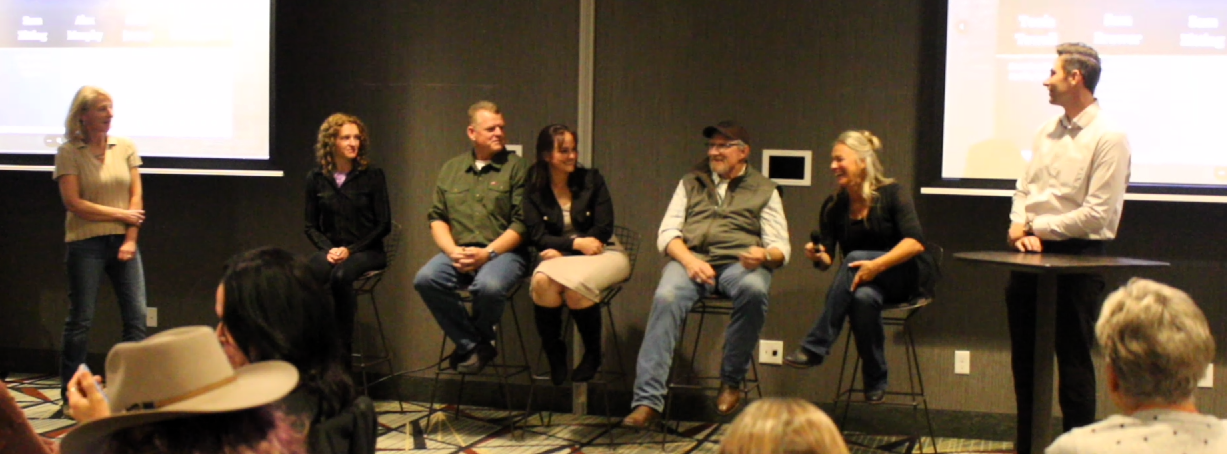
The night closed with a Q&A panel featuring nationally renowned author and private investigator Sam Brower, who led the seven-year investigation that resulted in the conviction of Warren Jeffs. Brower, a lead expert and witness for agencies including the U.S. Department of Justice, the FBI, and the Texas Department of Public Safety in multiple FLDS cases, shared his insights on the ongoing fight for accountability and justice. His book Prophet’s Prey—later adapted into an award-winning Sundance documentary—remains one of the most detailed examinations of the hidden world of the FLDS.
During the Q&A, Brower was asked how the Short Creek area has changed in recent years.
“It’s changed a lot from then to now. When I first started in 2003 and I started going down there, the entire police department was corrupt—the Marshal’s Office was corrupt. It was just myself, and Mohave County had assigned an investigator there, Gary Engles. Gary and I were just about the only ones there ever. They moved a trailer near where the college is, and we called that Fort Apache. We couldn’t step out without being followed, trailed, rocks thrown at us, people pulling us over, and everything else,” he said.
“It was lawless. Really.”
Brower explained that reform in Short Creek did not happen overnight, describing years of resistance, corruption, and fear that kept outsiders from making progress.
“Now there’s been so much progress,” he said. “The county attorneys, the FBI—Aaron’s task force—started coming on board and hearing about it more and more, until it got to the point where Warren told them they needed to leave Short Creek and be in the world, but not of the world.”
He went on to explain how this shift has created new challenges. “Before, they were in a consolidated group which made it easier to monitor, surveil, and maintain,” he said. “Now it’s much harder. The fact is, they’ve become more polished, more wealthy—and their businesses are thriving.”
Brower added that many former FLDS operations and families have since dispersed into surrounding regions, with a significant concentration now in Iron County. The move has made tracking their activities increasingly difficult, as many continue to live and work within tight-knit compounds and business networks that operate largely out of public view.
Reflecting on his work, he said he “kind of kicks over the hornet’s nest,” uncovering crimes and corruption, tracking and recovering missing FLDS children, while organizations like Holding Out HELP step in to protect and rebuild lives. He added that supporting the organization “is a way to get involved” and “an opportunity to help people.”
By the end of the evening, the message was clear: change begins with kindness and kindness begins with awareness. The stories, statistics, and shared humanity reminded everyone in the room that hope—and help—can ripple outward, creating waves of change.
At the commencement of the event, guests were encouraged to get involved and support the work of Holding Out HELP. The community can also make a difference by staying vigilant for suspicious activity, human trafficking, or other signs of abuse, and by reporting concerns to local authorities and HoH who can be reached at (801) 548-3492 or admin@holdingouthelp.org. In cases of immediate danger, authorities should be contacted at 911. Volunteers and donors are also welcomed to help HoH continue their mission.
Holding Out HELP (HoH) Contact Information:
- Website: https://holdingouthelp.org
- Phone (HELP Hotline): (801) 548-3492
Available Monday–Thursday, 9:00 AM–4:00 PM MST. After hours, they will contact you within 24–48 hours. - Email: help@holdingouthelp.org
- Mailing Address:
138 E 12300 S, Suite C #193
Draper, UT 84020
Highlights from the Holding out HELP Annual 2025 GALA
| Holding Out HELP PowerPoint Presentation |
| New Clients Served Each Year 2021–2022: 203 2022: 269 2023: 325 2024: 406 Crimes & Abuses Documented by HoH over the Past Five Years: CHILD TRAFFICKING AND SEXUAL EXPLOITATION: Two FLDS men caught attempting to transport girls as young as 9 for sexual exploitation. HUMAN TRAFFICKING ARRESTS: Three women arrested in connection with trafficking schemes. UNDERAGE & FORCED MARRIAGES: FLDS girls married as young as 15–17, often within family lines; Kingston Group documented in lawsuits. SEXUAL ABUSE AND RAPE: FLDS men coerced underage girls into sexual acts; one man gifted wives to male followers under “divine instruction.” MISSING CHILDREN: Multiple reports, including FLDS girls and boys, some disappearing without a trace; strategic rescues coordinated by HOH. WELFARE & SNAP FRAUD: FLDS members formally charged for benefit fraud while maintaining leadership positions. FINANCIAL CRIMES: Kingston Group sentenced for a $511 million tax fraud conspiracy connected to a biodiesel program; partnered with Lev Dermen, billionaire gas tycoon and alleged former leader of the Armenian Mafia. LEGAL ACTIONS & LAWSUITS: Former members filing suit for forced labor, sexual abuse, trafficking, and incestuous marriages; ongoing court cases highlight systematic abuse. OTHER ABUSES: Forced pregnancies, child labor, falsification of birth certificates, concealment of fathers’ identities, and operation of fraudulent banks. |
The Zion Times is deeply grateful to Tonia Tewell and Sam Brower for inviting us to the 2025 Annual Gala for Holding Out HELP. We were honored to witness the incredible stories of survivors, the resilience of families, and the profound impact of HoH’s work.

with
The Zion Times.
SOURCES:
Former FLDS members fear their children’s disappearance is part of Warren Jeffs’ prophecy – ABC News
About Us – Short Creek Dream Center
Ex-FLDS leader’s old home transforming into Short Creek Dream Center
Meet Sam Brower: The man who helped nab polygamous prophet Warren Jeffs – CultureMap Houston
Utah detective has chased polygamist outlaws to Sundance – The Salt Lake Tribune


Leave a Reply