
By: Sachet A. Sullivan | The Zion Times
Video and photography by Dawsyn Workman
For the last five days, 18 officers from four southern Utah counties traded their patrol routines for classroom sessions, role play, and tough conversations about mental illness. By Friday afternoon, they were on the floor of the Crisis Intervention Team (CIT) Academy, running live scenarios that tested the skills they spent the week learning.


Over the course of the week, officers rotated through classroom instruction covering both law and mental health. Lessons included an introduction to CIT, civil laws and liability, intervention strategies, children’s issues, and personality and borderline disorders. They also studied psychotropic medications, suicide assessment, PTSD, substance abuse and co-occurring disorders, non-psychiatric behaviors, along with CIT procedures and an overview of the Utah State Hospital.
Officers also spent time focused on the principles of de-escalation, where safety and communication were emphasized above force. Training stressed that officer safety is essential, containment of the situation is crucial, and only the minimum force necessary should be used. Instructors taught intervention strategies built around the acronym ACT — achieve contact, clarify issues, and take constructive action — supported by tools such as active listening, identifying emotional “hooks” and “triggers,” and applying core communication skills like paraphrasing, labeling emotions, and staying focused.

Officers were also tasked with practicing the “five R’s” of communication: reassuring, respectful, reliable, relatively simple, and resonating calmness. To reinforce safety, they were reminded of the DBEAT model — distance, backup, empathy, awareness, and time — along with other fundamental skills such as monitoring body, head, hands, eye contact, and distance during every encounter.
The CIT academy drew officers from the Iron County Jail, Cedar City Police Department, Southern Utah University Police, Adult Probation and Parole, Kanab Police Department, Beaver County Sheriff’s Office, and Santa Clara Police Department.
CIT Utah is directed by Dr. Todd Soutor, Ph.D., and his wife Danielle, who together oversee crisis intervention training across the state. Dr. Soutor is a licensed psychologist with nearly three decades of experience, while Danielle holds an MBA and more than 30 years of business management experience, manages officer registration, recertification, and program operations. Their program emphasizes de-escalation, empathy, and community partnerships in responding to mental health crises.

Regional coordinators for the academy included Cedar City Police Detective Corporal Patrick McCoy and John Brown, program manager at Southwest Behavioral Health, who worked alongside the Soutor’s to guide the training.
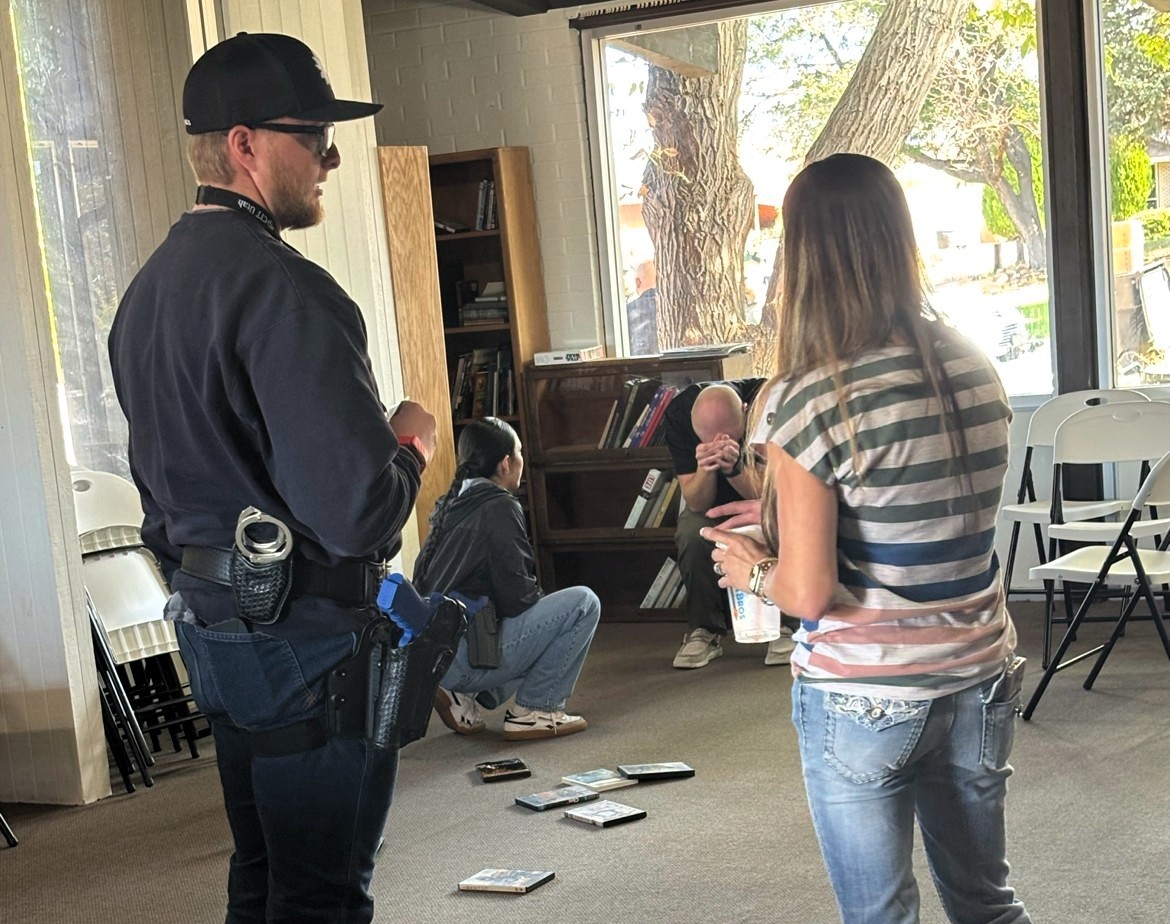
On Friday, officers finished the academy by working in pairs of four to face five different crises. In one, a mother tried desperately to corral her autistic teenage son as he repeated himself and threw books across the room. In another, a homeless man in a wheelchair sat beside a grocery basket in the park as officers were tasked with steering him toward help through the Crisis Stabilization Center.

The most intense role play involved a disabled veteran, heartbroken after his wife left, sitting in his vehicle with a gun tucked under his chin. The standoff ended not with tragedy, but with officers talking him down and walking him safely out of the vehicle. Another scenario highlighted when police must step back, calling in the Mobile Crisis Outreach Team (MCOT) to support a family overwhelmed by a mentally disabled son.

The final exercise put The Zion Times in the role of a woman gripped by paranoia, convinced hidden cameras were everywhere as part of an elaborate pornography ring watching her every move.
Each scenario was carefully structured with roles that went beyond the officers themselves. An evaluator — often a senior law enforcement officer — observed the interaction alongside a therapist intern and one of the program directors. At the conclusion of each exercise, the evaluator walked the group through how the scenario played out, pointing out what went well, where improvements could be made, and whether the situation met criteria for issuing a “pink slip,” the legal form in Utah used to initiate an involuntary mental health hold. Evaluators also addressed whether any constitutional rights may have been infringed during the response.

Throughout the training, officers practiced being firm when safety required it, yet encouraging and empathetic toward the individuals they encountered — striking a balance meant to calm crises rather than escalate them.
When speaking with program director Dr. Soutor, The Zion Times asked about the difference between drug-induced schizophrenia and a general medical diagnosis and how officers differentiate between the two. Dr. Soutor explained that the purpose of CIT is to equip officers to “recognize the symptoms, treat them with empathy, and look deeper to understand the underlying cause of what is happening.” “Maybe we find something different,” he said, adding that rather than defaulting to jail, officers are trained to consider resources such as the Mobile Crisis Outreach Team (MCOT) and the Crisis Stabilization Center to connect people with treatment.
Officials explained that the Crisis Stabilization Center (CSC) is located in Hurricane, Utah and serves as a voluntary 24/7 facility that offers immediate support and safety for adults experiencing a mental health crisis. Most clients stay around 23 hours, or until the crisis has been stabilized. During that time, they receive individualized crisis assessments and access to support services, including coordination with community resources. The CSC also serves as an alternative for law enforcement — meaning that when appropriate, officers may take someone in crisis there instead of to a hospital emergency department or jail.

They also highlighted the role of the Mobile Crisis Outreach Team, or MCOT, a state-run service that pairs mental health professionals with peer specialists who can respond in the community when someone is in crisis. Operating 24/7 across Utah, MCOT teams meet people where they are — at home, in public, or alongside law enforcement — to de-escalate situations, provide assessments, and connect individuals to ongoing treatment or resources.
“We’re taught to treat these situations as medical crises first, not criminal cases,” Det. McCoy said. “That means slowing things down, keeping people safe, and using the least amount of force necessary while still protecting the public and the officers on scene.”

Det. McCoy explained that officer discretion plays a critical role in mental health crises. Rather than defaulting to enforcement, he said officers are encouraged to look at the situation as a medical condition first — treating the immediate needs of the individual before considering criminal charges.
Dr. Souter also explained how CIT is designed to fill the gap between mental health and law enforcement. It gives officers practical tools to recognize when a situation is rooted in illness rather than crime, while connecting individuals to treatment instead of the justice system. By bridging these two worlds, CIT is meant to reduce jail bookings, ease pressure on emergency rooms, and build trust between police and the communities they serve.

At the conclusion of the academy, officers were required to take a written exam measuring what they had learned throughout the week. The test covered topics such as recognizing symptoms of mental illness, applying de-escalation techniques, and understanding when to involve resources like MCOT or the Crisis Stabilization Center. Passing the exam is part of earning certification through CIT Utah, underscoring that the training is both practical and academic.
Each role was designed to be uncomfortable and unforgettable. Organizers said that’s the point. The academy’s goal is to help officers recognize mental illness, reduce stigma, and find ways to de-escalate before situations spiral.
CIT Utah continues to expand across the state, with academies like this one building bridges between law enforcement, mental health professionals, and the communities they serve. More information is available at cit-utah.com.
The Zion Times extends our sincere thanks to CIT Utah, Dr. Todd and Danielle Soutor, as well as the regional coordinators for allowing us to be part of the academy. It was an honor to learn alongside the men and women who protect and serve, and to gain new perspective on the challenges they face when responding to mental health crises.

Not every moment at the academy was heavy. Between scenarios, there were plenty of laughs and outtakes — from role players hamming it up to officers trying to keep a straight face during training mishaps. These extra photos capture some of the lighter moments that didn’t make it into the main story, but remind us that even in serious training, humor has a way of breaking through. However, viewer discretion is advised on a few of the extras. Please be advised.



Leave a Reply to “HE TREATED ME LIKE A PERSON” : CEDAR CITY RESIDENTS REFLECT ON ONE OFFICER WHOSE CHANGING LIVESCancel reply