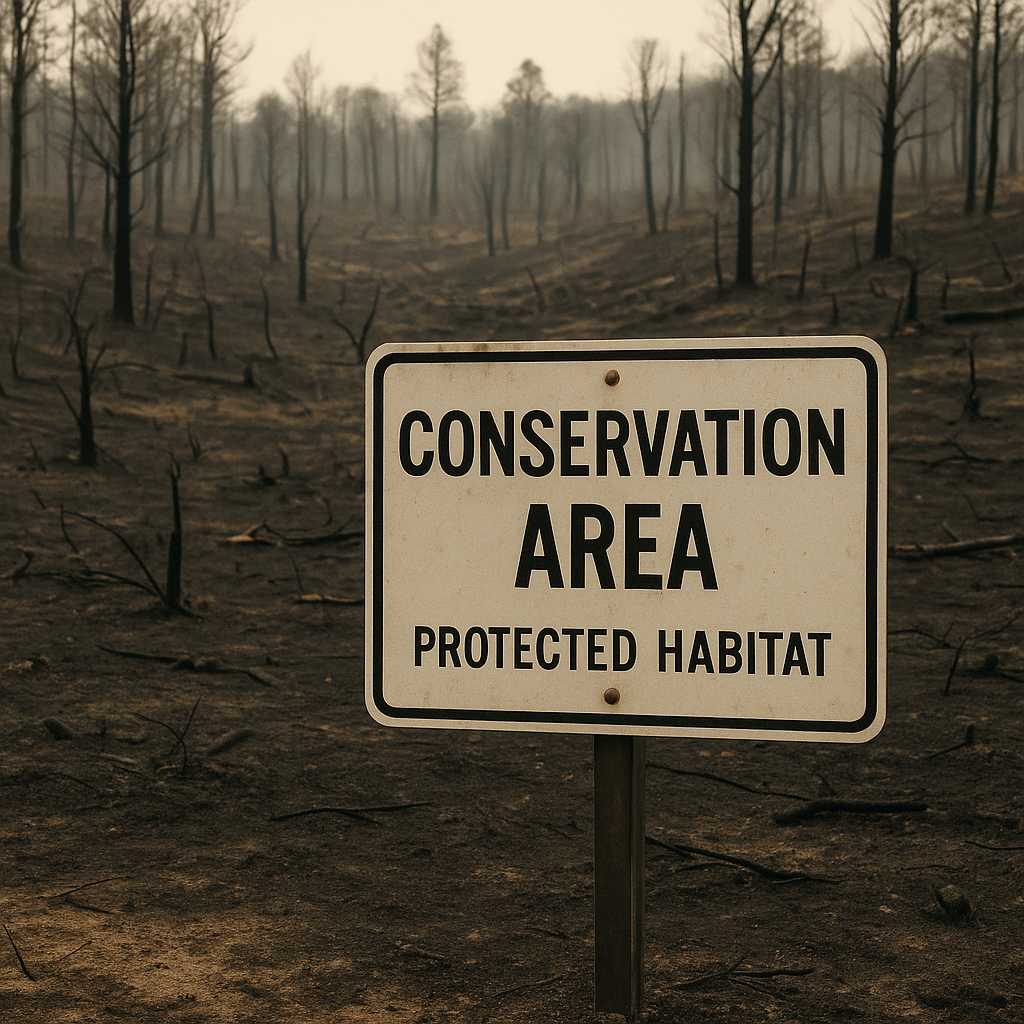

By Sachet A. Sullivan | The Zion Times
As wildfire season grows longer and more destructive across the American West, many are asking whether something deeper is fueling the flames. While officials point to drought, overgrown forests, and climate change, others are examining broader policy frameworks that shaped how we manage our forests—and who ultimately benefits from these burned landscapes.

At the center of this discussion is Agenda 2030, a global framework adopted by the United Nations in 2015, encompassing 17 Sustainable Development Goals (SDGs) aimed at reducing poverty, managing natural resources, and responding to environmental challenges.
The real-world rollout of these goals—particularly in fire-prone regions—brings new questions to the surface.

WHAT IS AGENDA 2030?
Agenda 2030 is a non-binding global action plan agreed to by 193 countries, including the United States. It builds upon Agenda 21 (1992), focusing on sustainable development, land use, and environmental stewardship.
Key pillars include:
- Transitioning to clean energy
- Restructuring infrastructure and urban design
- Expanding protected lands
- Reducing rural development in favor of “conservation”
While voluntary at the national level, the framework often filters down locally through zoning revisions, grant incentives, federal funds, and mitigation programs tied to these goals.

The goals most often linked to post-wildfire policies are:
- SDG 9: Industry, Innovation, and Infrastructure
Promotes resilient infrastructure, technological innovation, and access to communications technology. This goal often underpins the expansion of smart grids, broadband systems, and remote monitoring—frequently seen in federally funded rebuild efforts. - SDG 11: Sustainable Cities and Communities
Focuses on compact development, limiting rural sprawl, and increasing resilience to disasters. - SDG 13: Climate Action
Encourages governments to adapt infrastructure and development to meet climate targets—including through land use regulation. - SDG 15: Life on Land
Emphasizes restoring ecosystems, managing forests, and increasing conservation—often through land acquisition or rewilding programs.

SDG 9: INDUSTRY, INNOVATION AND INFRASTRUCTURE
This goal promotes resilient infrastructure, technological innovation, and access to communication systems.
While SDG 9 is broadly framed to support economic growth and sustainability, it has become a central justification for deploying smart grids, broadband networks, IoT systems, and digital monitoring infrastructure.
Federal recovery programs like FEMA, HUD, and USDA grants often prioritize rural and post-disaster regions—using SDG 9-aligned language to fund “resilience” upgrades such as smart meters, remote shutoff systems, and sensor-based land monitoring. These programs are marketed as tools for modernization and risk reduction, but their rollout can reshape local autonomy and land use—especially in wildfire-prone communities.
WILDFIRES AND THE PUSH FOR “REWILIDING”
When a major wildfire burns private property, agencies frequently designate the area as a temporary disaster zone. Post-fire, land becomes subject to increased regulation—often in the name of rehabilitation or diminishing future risk, aligning closely with the above SDGs.
This process often resembles managed retreats—a strategy described by environmental planners—in which damaged properties are sometimes bought out or sold to non-governmental organizations (NGOs) and converted into buffer zones, conservation lands, or non-developable easements, curtailing private rebuilding.

FEMA’s Hazard Mitigation Grant Program guidelines state properties damaged by wildfires, floods, or other disasters may be eligible for voluntary buyouts, provided the land is permanently maintained as open space or for conservation use.

These transitions are intended to reduce long-term risk—but also result in restrictions on private rebuilding and expanded regulation of post-disaster lands.
Property rights advocates trace these land-use shifts back to ideological roots. According to The Communist Manifesto (1848), one of Karl Marx’s first steps toward a classless society was “the abolition of property in land and application of all rents of land to public purposes.”
By contrast, private property has long been regarded as a cornerstone of constitutional republics, safeguarding individual sovereignty against state overreach.
Some argue that Agenda 2030’s land-consolidation mechanisms—especially post-disaster buyouts, strict zoning, and conservation easements—echo Marx’s vision by steadily moving land from private hands into collective or government-controlled stewardship.
LOCALIZED AGENDA 2030
One of the most effective tools for implementing Agenda 21 and Agenda 2030 principles at the local level is through Community Wildfire Protection Plans (CWPPs).
A CWPP spells out how a community plans to deal with wildfire danger—usually by cutting back brush, clearing defensible space, and setting up fuel breaks. But these plans also influence where people can rebuild after a fire. In some cases, they recommend keeping burned areas undeveloped or turning them into buffer zones.
Originally promoted under the 2003 Healthy Forests Restoration Act, CWPPs were designed to help communities identify wildfire risks and guide mitigation efforts. Over time, some plans have evolved to include broader resilience strategies that influence land use—often adopting language aligned with sustainability goals like rewilding, conservation zoning, and post-disaster land management.
In Iron County, there are seven Community Wildfire Protection Plans (CWPPs)—including those for Rainbow Meadows, Brian Head, Far West/Comstock, Cedar Highlands, Quichipa, New Castle, and Old Irontown—according to the Wildland Fire Protection Plan published by Garkane Energy Cooperative in July 2024 (Revision V2, p. 10).
These CWPPs are integrated into a broader regional strategy that connects local fire management with land-use planning and hazard mitigation efforts across surrounding counties.
While meant to reduce future risk, this kind of guidance lines up with Agenda 2030 goals—SDG 13 (Climate Action) and SDG 15 (Life on Land)—which promote more government control over land use and limit rural development in the name of “resilience.”
In many counties across the West, wildfire planning often includes zoning rules, subdivision ordinances, and land-use tools like setbacks, clustered development, and stricter infrastructure standards. These measures are typically framed as ways to reduce risk in fire-prone areas, but they also shape how—and where—rural property owners can build or rebuild.
Clustered development is a land-use strategy where buildings—especially residential homes—are grouped together on a smaller portion of a parcel, while the remaining land is left open for shared green space, natural vegetation, agriculture, or conservation.
In simple terms, instead of spreading houses evenly across a large area (which takes up more land and requires more roads, utilities, and fire protection), clustered development places homes closer together— so the rest of the land can be preserved. While framed as fire mitigation, these tools restrict property use for rural landowners and can create long-term limitations that persist well after fire danger subsides.
SURVEILLANCE, SMART CITIES & RESILIENCE GRANTS
FEMA, HUD, and USDA recovery grants commonly require resilience and digital infrastructure upgrades that echo SDG 9 (Industry, Innovation, Infrastructure), SDG 13 (Climate Action), and SDG 15 (Life on Land).
Post-fire recovery often demands:
- Smart meters or broadband-ready systems
- Inclusion of state-mandated monitoring
- Zoning clauses limiting livestock or water use on regenerated land
- Voluntary buyouts of damaged homes, followed by demolition or relocation
- Property acquisition using FEMA funds, with ownership transferred to local governments
- Prohibition on beginning mitigation work before official approval
According to FEMA’s Hazard Mitigation Grant Program (HMGP), homeowners cannot apply directly but may participate through local or tribal governments. The program typically covers 75% of approved costs. Wildfire mitigation projects may also include fire-resistant building materials and clearing vegetation around homes.
SMART RECOVERY OR SMART CONTROL? LAND, DATA AND POST-FIRE RECOVERY
The term SMART isn’t just about technology— many argue it’s a tool embedded into Agenda 21 and Agenda 2030 to monitor, assess, and ultimately control land use and individual behavior.
Originally meaning:
- Specific
- Measurable
- Achievable
- Relevant
- Time-bound
In practice, SMART systems now collect real-time data on land, utilities, mobility, farming, and consumption—often without direct public approval.
Examples include:
- SMART Growth: urban zoning that discourages rural life and drives populations into dense, surveilled city centers.
- SMART Meters: real-time water and power monitoring, enabling rationing or remote shutoffs.
- SMART Agriculture: sensor-based control of livestock, irrigation, and crop outputs.
- SMART Forests: satellite-managed zones that become restricted or rewilded after fires.
- SMART Cities: surveillance infrastructure rolled into transportation, emergency response, and rebuilding projects.

(Source: Bold Awards, “Climate Smart Agriculture: Bold Path, Bright Future”)
These systems aren’t accidental. A 2025 peer-reviewed study published in Discover Sustainability mapped the rise of technologies driving global sustainability policy. It found that nearly all key innovations embedded in recovery programs—such as smart meters, AI surveillance, broadband-linked infrastructure, and sensor-based monitoring—surged in relevance only after Agenda 2030 was adopted.
Technologies like Smart Governance, Smart Agriculture, and IoT applications for land management all peaked between 2020 and 2023, following the global SDG rollout. The research shows how these tools evolved not just from innovation, but from alignment with SDG mandates—particularly Goals 9, 11, and 13.

Timeline showing when technologies like smart meters, IoT, and precision monitoring became dominant in global sustainability policy—mostly after Agenda 2030 was adopted.
(Source: Discover Sustainability, 2025)
Critics argue that while these programs are promoted as tools for sustainability, they concentrate control over land, enable constant surveillance under unelected entities, and often use environmental disasters as a justification for expanded authority.
Power Down: SMART Control in Real Time
According to Rocky Mountain Power and Cedar City officials, approximately 6,500 customers in Central and Southern Utah experienced planned power shutoffs over the weekend under a Public Safety Power Shutoff (PSPS) protocol. The company cited “hazardous wildfire conditions” and strong winds as the reason for the precautionary outage. This marked the first time PSPS protocols were implemented in Utah, signaling a broader move toward remotely managed, digitally integrated utility systems.
This real-time event illustrates how SMART grid infrastructure—while designed to increase safety and resilience—can also centralize emergency decision-making, which, raises questions about landowner autonomy and control.
While SDG 9 promotes resilient infrastructure and innovation, implementation in high-risk zones increasingly intersects with debates over access, oversight, and local input during disasters.
WHAT THE PUBLIC CAN DO
- Review local zoning/changing county plans—watch for Agenda 2030 language, resilience clauses, or WUI redesignation.
- Request FEMA/HUD/USDA recovery and wildfire grant documents using GRAMA or FOIA.
- Stay alert at local fire commission meetings, particularly in Iron, Washington and Kane counties, where wildfire mitigation funding is discussed.
- Read Agenda 2030 SDGs 9, 11, 13 & 15 closely, and compare focus areas to local rural land-use regulations.
QUESTIONS THE PUBLIC SHOULD BE ASKING:
As fire seasons intensify and post-wildfire regulations grow more complex, the public has a right to clear, accountable answers from elected officials and agency leaders. These are just a few questions Utahns should consider raising at town halls, commission meetings, or directly to the Governor’s Office:
- Are any federal or state wildfire recovery grants contingent on adopting Agenda 2030-aligned land-use or zoning policies?
- Will post-fire land buyouts involve outside NGOs or “rewilding” partnerships?
- Is there a plan to protect private property rights in fire zones from permanent conservation conversion or building restrictions?
- Are smart city systems—like surveillance infrastructure or broadband-linked utilities—being added to fire recovery projects without public consent?
- Do FEMA or HUD grants require homeowners to accept new climate-based mandates, such as solar installation, irrigation limits, or livestock bans?
- Which counties in Utah are now required to align their wildfire plans with UN Sustainable Development Goals (SDGs)?
Rural residents should not have to choose between rebuilding their homes and surrendering their autonomy. These questions are essential to protecting both.
FINAL WORD
Agenda 2030 may not ignite the flames—but the wildfire policies that follow can reshape the land more permanently than fire itself. As Iron, Washington, and Kane Counties face increasing fire seasons, citizens deserve full transparency on what happens after the flames cool—and who decides the future of these lands.


SOURCES:
Sources:
United Nations Agenda 2030 (SDGs 11,13,15)
https://sdgs.un.org/goals
SW Utah Regional Wildfire Protection Planning (Iron & Washington County CWPPs)
https://pscdocs.utah.gov/electric/25docs/2502802/338360GarkaneEnrg2023WldlndFrCmplncRprt2-19-2025.pdf
SW Utah Regional Wildfire Protection Planning (Iron & Washington County CWPPs)
https://www.fivecounty.utah.gov/wildfire.html
Garkane Energy Cooperative. Wildland Fire Protection Plan. July 2024, Revision V2.
https://pscdocs.utah.gov/electric/25docs/2502802/338360GarkaneEnrg2023WldlndFrCmplncRprt2-19-2025.pdf
BLM Color Country Stage 1 Fire Restrictions – June 2025
https://www.blm.gov/programs/fire/regional-info/utah/fire-restrictions
Southwest Utah Regional Wildfire Protection Planning (Iron, Washington, Kane CWPPs)
https://pscdocs.utah.gov/electric/25docs/2502802/338360GarkaneEnrg2023WldlndFrCmplncRprt2-19-2025.pdf
Five County Association of Governments – Wildfire Planning
https://hazards.utah.gov/wp-content/uploads/2023/09/2023-SWUT-RWPP.pdf
BLM Color Country Stage 1 Fire Restrictions – June 2025
https://www.blm.gov/programs/fire/regional-info/utah/fire-restrictions
Washington County Fire Restriction Update
https://kutv.com/news/local/stage-1-fire-restrictions-in-effect-across-several-utah-counties
KUTV / KJZZ – Stage 1 Restrictions in SW Utah (Washington/Kane)
https://kutv.com/news/local/stage-1-fire-restrictions-in-effect-across-several-utah-counties
Kane County Town Hall – Vermillion Cliffs Fire SSD
https://www.sunews.net/post/kane-county-holds-fire-ssd-town-hall-county-treasurer-offers-projections-on-potential-fees
Kane County General Plan – Fire Vegetation & WUI Policies
https://www.kane.utah.gov/DocumentCenter/View/267/2018-Kane-County-General-Plan-PDF
2018 Kane County General Plan – Fire, Vegetation, and WUI Policies
https://www.kane.utah.gov/DocumentCenter/View/267/2018-Kane-County-General-Plan-PDF (pp. 18–21)
Utah Fire Info – Active Fire Restrictions (BLM/NPS statewide)
https://utah-fire-info-utahdnr.hub.arcgis.com/pages/active-fire-restrictions
FEMA Homeowner’s Guide to the Hazard Mitigation Grant Program (2016)
https://www.fema.gov/sites/default/files/documents/fema_homeowners_guide_hazard_mitigation_grant_program_11-04-16.pdf
FEMA Hazard Mitigation Grant Program Post Fire
https://www.fema.gov/grants/mitigation/learn/post-fire
2024 FEMA Hazard Mitigation Assistance Program and Policy Guide
https://www.fema.gov/grants/mitigation/learn/hazard-mitigation
FEMA Wildfire Mitigation & Resilience Grants
https://www.fema.gov/sites/default/files/documents/fema_building-codes-wildfires-guide.pdf
FEMA Hazard Mitigation Assistance Program and Policy Guide (May 22, 2025)
https://www.fema.gov/grants/mitigation/learn/hazard-mitigation-assistance-guidance
HUD Disaster Resilience Funding
https://www.hud.gov/program_offices/spm/gmomgmt/grantsinfo/disaster-resilience
Kara Holsopple. “After Fire, Forest Land Often Changes Hands.” High Country News, June 6, 2023.
https://www.hcn.org/issues/55.6/wildfire-after-fire-forest-land-often-changes-hands
Guy Carpenter & Conservation Biology Institute. “Quantifying Insurance Benefits of a Nature-Based Approach to Reducing Risk: Wildfire Risk Reduction Buffers.”
https://www.guycarp.com/insights/2021/12/wildfire-risk-reduction-buffers.html
North American Land Trust – website information on post-fire conservation easements
https://www.nalt.org
Save the Redwoods League – organization’s conservation land acquisition practices
https://www.savetheredwoods.org
Rainforest Alliance – forest fire prevention through sustainable land practices
https://www.rainforest-alliance.org
Blue Forest Conservation – Forest Resilience Bond for wildfire buffer creation
https://www.blueforest.org
National Fire Protection Association (NFPA). “Defensible Space and Home Ignition Zones.” Accessed June 2025.
https://www.nfpa.org/education-and-research/wildfire/home-ignition-zone.
SDG Technology Drivers & Intion Frameworks – NBT (Next Big Thing AG)
https://nextbigthing.ag/blog/the-role-of-sustainable-technologies-in-achieving-sdgs/
Images: “SDG Tech Applications & Smart Monitoring” – NBT AG
Uploaded from:
https://nextbigthing.ag/blog/the-role-of-sustainable-technologies-in-achieving-sdgs/
Includes:
– SDG Technology Drivers and Innovation Frameworks (IoT, AI, Big Data, Drones)
– Smart Agriculture & Monitoring Conceptual Visuals
– Precision Monitoring Use Cases under Agenda 2030
SDG Technology & Policy Alignment Trends – Discover Sustainability (2025)
https://link.springer.com/article/10.1007/s43621-025-01210-z
The Communist Manifesto – Karl Marx & Friedrich Engels (1848)
https://www.marxists.org/archive/marx/works/1848/communist-manifesto/
United Nations, “The 17 Sustainable Development Goals,” United Nations Department of Economic and Social Affairs – Sustainable Development
https://sdgs.un.org/goals
Rocky Mountain Power – PSPS Update: https://www.rockymountainpower.net/outages-safety/psps.html
Cedar City Government – PSPS Advisory (Facebook): https://www.facebook.com/photo.php?fbid=10233970214232095
ABC4 News: “Power shutoffs hit central and southern Utah over the weekend”
https://www.abc4.com/news/top-stories/power-shutoff-central-southern-utah/
United Nations – Sustainable Development Goal 9 (Industry, Innovation & Infrastructure):
https://sdgs.un.org/goals/goal9
United Nations Agenda 2030 (SDGs 9, 11, 13, 15)
https://sdgs.un.org/goals
FEMA Wildfire Mitigation & Resilience Grants
https://www.fema.gov/sites/default/files/documents/fema_building-codes-wildfires-guide.pdf
HUD Disaster Resilience Funding
https://www.hud.gov/program_offices/spm/gmomgmt/grantsinfo/disaster-resilience
USDA Climate-Smart Infrastructure and Recovery Initiatives
https://www.usda.gov/climate-solutions/climate-smart-agriculture
Discover Sustainability (2025) – Tech Trends Driving SDG Implementation
https://link.springer.com/article/10.1007/s43621-025-01210-z
Remote Sensing (MDPI, 2023) – Vision 2030 & SDG Alignment Graphic
https://www.mdpi.com/2072-4292/15/24/5770
Next Big Thing AG – The Role of Sustainable Technologies in Achieving SDGs
https://nextbigthing.ag/blog/the-role-of-sustainable-technologies-in-achieving-sdgs/

Leave a Reply